The Same Within the Similar
Repetition, Shift and Transformation
The headline describes a central tension that defines Ingo Gerckens’ artistic practice: the relationship between repetition and difference, between continuity and transformation. His works explore how a motif, an image fragment or a visual structure persists across changing medial and material contexts without entirely losing its visual identity.
Gerckens assumes that each medium carries an inherent layer of information that fundamentally shapes how we perceive and interpret images. By continuously shifting between media, he deliberately puts this condition to the test.
“The Same Within the Similar” thus becomes a guiding principle of an artistic attitude focused less on fixed forms than on process. Gerckens’ works are not completed images but states in flux. They reveal that identity is not static but processual – that an image does not cease to be “the same” even as it appears differently under changing medial conditions.
In the interplay of differing image qualities, surfaces and materialities, the true dynamic of his work becomes apparent: the image is no longer understood as a site of singular meaning but as an open field of perception.
Gerckens’ art reflects, in its own way, the effects of today’s media environments. In a time when not only the frequency of reproduction but also the constant emergence of images in ever-changing forms – not only digital – reshape how we assign value, both image and perception undergo a fundamental shift. In his work, Gerckens uses this development creatively as an opportunity to open new visual and conceptual spaces in which perception and meaning are continually renegotiated.
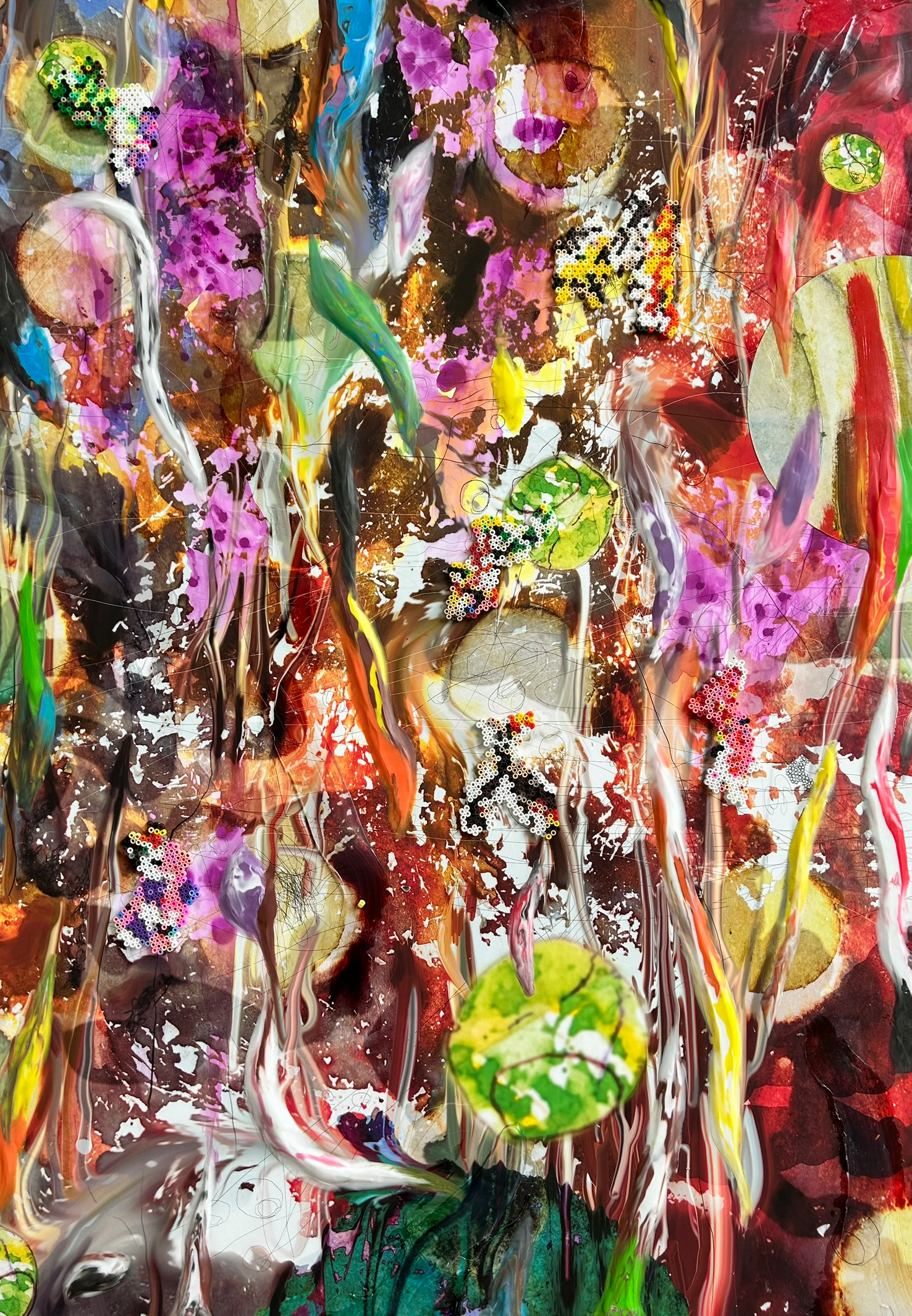
Individual elements remain identifiable, while the whole can no longer be described as a single motif.
New media, social networks and artificial intelligence are changing how we see, understand and interpret. The speed of these developments is increasing rapidly.
As a result it becomes harder to maintain a fixed perspective. Our minds must constantly adapt to process the flood of visual information.
This rapid transformation is the starting point for Ingo Gerckens’ work. He examines when an image loses its meaning, when it escapes language. How do we cope when we can no longer name what we see?
Gerckens develops his visual worlds through processes of juxtaposition, translation and transformation. Digital fragments, photographic sources or original paintings are resampled and inscribed to new surfaces. The essence of the original material – the “same” – remains present, while through formal and material repetition – the “similar” – it continually assumes new form. This process of circulating transformation produces works that oscillate between recognisability and dissolution. The eye searches for familiar shapes, yet the image resists this process